Categories
About
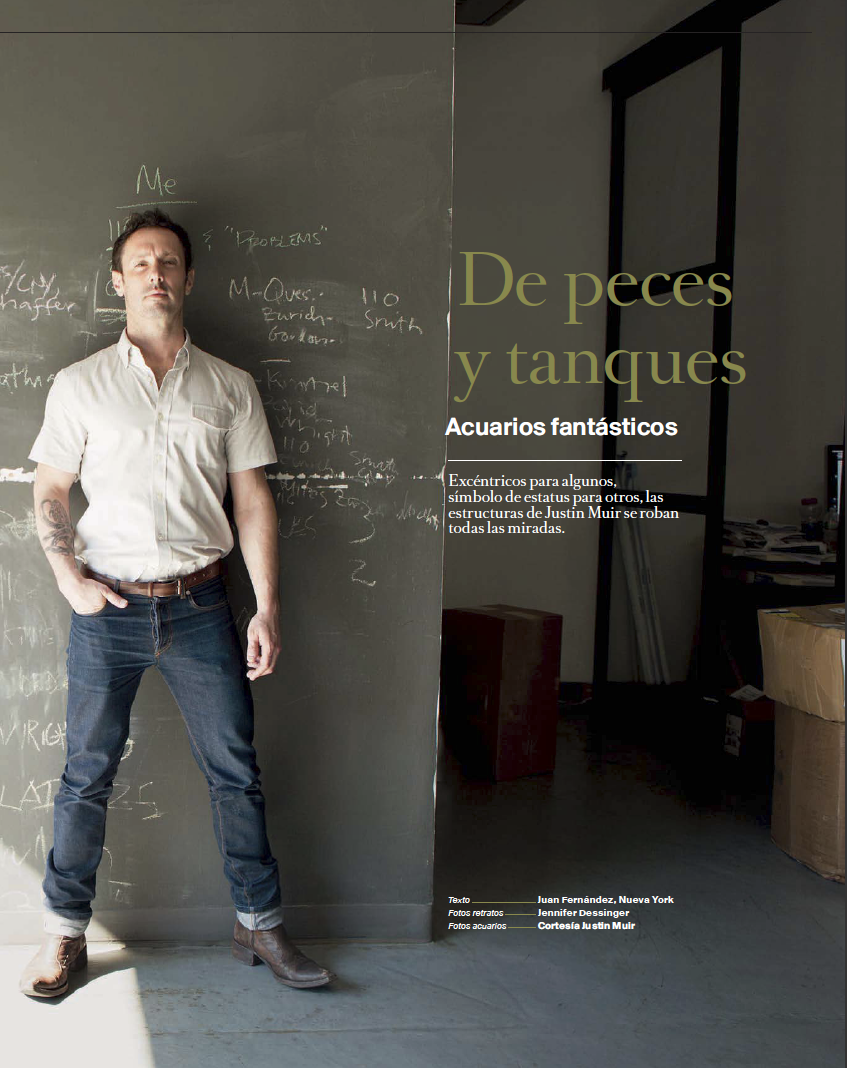
- Justin is the American
- designer whose
- signature vision
- elevates custom
- aquarium installations
- to a new aesthetic.
Recent Press
 |
 |
 |
 |
 |
 |
 |
 |
 |
Shelly Eversley
800.304.9964
Archives
What We Read
Featured Projects
 |
Galactica |
 |
Soho Flat |
 |
zen in Gramercy |
Fox 5 News Takes a Dive with City Aquarium

 This week Fox 5 News here in NYC joined us at the Staten Island Ferry Terminal to learn how we clean these twin 2,000 gallon freshwater tanks. This week Fox 5 News here in NYC joined us at the Staten Island Ferry Terminal to learn how we clean these twin 2,000 gallon freshwater tanks.The segment, called "Jen at Work," typically involves host Jennifer Lahmers getting her hands dirty, literally, at a different workplace every week. Jennifer met up with City Aquarium aquarists James Hoehlein and Casey Carter, who gave her the 411 on tank cleaning. Not only did Jennifer get to feed the Pacus, Arowana, and Jack Dempsey Cichlids, but she climbed inside the tank to scrub the artificial insert. While some of the larger fish "freaked" Jen out, she managed to complete the job and make the insert shine. The segment can be watched here: http://www.fox5ny.com/news/32899881-story Thanks to Jose Salvador and Jen Lahmers for reaching out to us. We had a blast!  |
New Fish Make a Splash at SI Ferry
|
Every once and a while we will receive a request from someone who wants to donate their fish. While we always seek to help find new homes for fish, we can't always accommodate these requests due to our high standards for livestock. But a couple of weeks ago we were given an offer we couldn't refuse. The proud owner of a 12" Red-Belly Pacu, 10" Tin Foil Barbs, and a bevy of large Cichlids (Jack Dempsey's, Sunshine, Peacocks, etc.) contacted us, explaining that he was moving out of town and was hoping to give his pets a new home -- in this case, the Staten Island Ferry fish tanks. The twin tanks, which City Aquarium has been maintaining since 2009, were once saltwater installations. We renovated them after Hurricane Sandy struck and reopened them about a year ago as freshwater systems. Fortunately, the client's fish were in great health and looked terrific. So, last week, aquarists Casey Carter and James Biggers did the honors of introducing the new fish to the tanks. We hope the people of SI and who visit the Ferry like the new denizens. And we're glad to have helped a pet owner in need.  |
Pre-School Goes Peacock!
|
It has been a while since we've posted here and the cyber cobwebs have accumulated. But, starting today, we will return to our blog with regular monthly (and, perhaps, even weekly) posts.
City Aquarium recently constructed a 165-gallon freshwater tank for a wonderfully imaginative pre-school in Brooklyn, NY, The Brooklyn Pre-School of Science. The owner of the pre-school, who goes by the name of "Carmelo the Science Fellow," believes in the importance of teaching children, even as young as 5, basic science. To that end, the pre-school contains five terrariums, a large planted wall, and now a tank of African Cichlids. For decor, we chose Texas Holey Rock, a limestone rock with a honeycomb-like appearance. We populated the tank mostly with Peacocks, choosing males for their bright colors. The emphasis in our trade is usually on colorful saltwater fish, but, while there's truth to that, African Cichlids are not a bad alternative. The smiles on the kids' faces can certainly attest to that. In fact, one film-savvy kid has already named the Fire Queen Cichlid... wait for it... "Nemo"! |
Fish Tanks Reopen At SI Ferry Terminal
 After the devastation wrought by Hurricane Sandy, the Staten Island Ferry Tanks are back and better than ever. City Aquarium recently undertook the challenge of rebooting the damaged tanks and converting them to freshwater. The impetus for the freshwater conversion stemmed from the Borough's desire to cut down maintenance costs and simplify the upkeep. But just because we went freshwater, does not mean we sacrificed beauty. Culling fish from both the South America's Amazon River and Lake Malawi and Tanganyika in Africa, we selected over 18 species of colorful and exotic fish -- and there's still more to come! And, while most of the fish are juveniles and still tiny, they will grow very large in the coming months and years. The tanks were unveiled to the public on Thursday, June 13th. To see a clip of the press conference and unveiling, please check out NY-1 News or SI Live News. |
The Age of Aquarium!
 This past Sunday MSNBC's "Your Business" sat down with City Aquarium to learn how Justin and the crew manage the day to day work of designing, installing, and maintaining tanks. To view the segment, click here.   |
Fish Tank Delegating
 This Sunday, February 24th, MSNBC will delve into the world of aquariums to learn how Justin went from a one-man show to having a reliable staff of managers, installers, and service techs. The segment, which will air at 7:30am and later appear on their website, is part of a regular segment called Your Business, which covers issues affecting small business owners. For the segment, the MSNBC crew interviewed Justin at our studio in Brooklyn, then took off to see several clients, including the proud new owner of a shark tank. Don't miss the show this Sunday at 7:30am. A link to the segment will be posted on our blog, so check back soon! |
City Aquarium goes Hollywood!
 Recently City Aquarium built a custom tank for the set of director Martin Scorcese's new film, "The Wolf of Wall Street." The film, starring Leonardo DiCaprio, Matthew McConaughey, and Jonah Hill, among others, traces the prodigal and crime-ridden life of Wall Street broker, Jordan Belfort, as he refuses to cooperate in a large securities fraud case in the early 1990's. Recently City Aquarium built a custom tank for the set of director Martin Scorcese's new film, "The Wolf of Wall Street." The film, starring Leonardo DiCaprio, Matthew McConaughey, and Jonah Hill, among others, traces the prodigal and crime-ridden life of Wall Street broker, Jordan Belfort, as he refuses to cooperate in a large securities fraud case in the early 1990's.Mr. Scorcese tapped City Aquarium to build a custom saltwater tank, about 8 feet in length, as part of the luxurious decor of a Swiss banker's office. City Aquarium was on set during the filming to ensure that the fish stayed fed and healthy and that the tank ran smoothly. Mr. Scorcese seemed pleased with the aquarium, at one point declaring that a certain Golden Puffer was a "genius." Apparently, Leonardo has some competition! Look for the aquarium when the movie hits theaters in 2013.  Labels: Martin Scorcese, movie, press, saltwater installation, The Wolf of Wall Street |
A Walk in the Woods, A Swim in the Tank
 Flat Rock Brook Nature Center, a 150-acre preserve and educational center located in Englewood, New Jersey, recently held their grand opening of "A Walk in the Woods" -- a new, interactive exhibit for adults and children alike. Among the taxidermy, the artificial trees, and the live reptiles could be seen a 535-gallon custom aquarium built by City Aquarium. The tank will host turtles as well as fish, both of which are native to Flat Rock's forests. The artificial insert, with its sprouting cattails and mud banks, was likewise designed to mirror the natural woodland. We were happy to be part of this exciting new project from an institution that's been around since 1973. Photos from the "A Walk in the Woods" grand opening can be seen here. |
Wall Street Journal Visits City Aquarium
 We thank WSJ for creating an informative and fun introduction to City Aquarium and our work. And don't be intimidated by the title -- our custom aquariums have a wide range of prices.  |
The Illusion of Serenity -- CA in the NY Times!
 “More volume of water is always the better bet," Justin told reporter, Douglas QuenQua. "It basically keeps the fish healthier, and the tank is more stable.” To read the full article, click here. |
CA Makes a Splash in Summus Magazine
       Labels: press, Summus Magazine |
City Aquarium Catches "Spring Fever"
 This past Wednesday evening, the Lenox Hill Neighborhood House, a popular non-profit in New York City, hosted their annual spring gala at Cipriani. For the event well-known NYC designers were tapped to create striking "Spring Fever"-themed centerpieces. So, when interior designer, Christopher Stevens, came knocking on our door, we were glad to help. The result of our collaboration can be seen in the accompanying photo (© Patrick McMullan Photography). A coral fossil was placed inside an acrylic cylinder; then, we added glass shards and LED crystal lights. Finally, when the cylinder was filled, seahorses and cardinals were acclimated and placed inside. Labels: Christopher Stevens, City Aquarium, Lenox Hill Neighborhood House, non-profit work |
Extra! Extra! CA in Pet Product News!
 In the latest issue of Pet Product News, the top monthly news source for the professional pet industry, editor LaRue Palmer takes a closer look at the world of customs aquariums. From the recession's chilling effect on sales to the benefits of acrylic over glass, Palmer investigates a variety of trends. City Aquarium owner, Justin Muir, was happy to sit down with Palmer and give the skinny on the state of the industry. To read the entire article, click here. Labels: City Aquarium, justin muir, pet product news, press |
NY1 News: A City Aquarium Success!
 Recently NY1 News asked to film City Aquarium about our maintenance of the two saltwater aquariums at the Staten Island Ferry Terminal. After a tumultuous beginning for the tanks, in which many fish died off, Borough President James Molinaro and the Staten Island Zoological Society turned to City Aquarium with high hopes. Thankfully, the tanks are now flourishing. The fish are hardier and less crowded than before, and the acrylic tanks themselves cleaner than ever before. To hear more about this incredible turn-around and watch the news clip, please click here. Labels: City Aquarium, press, Staten Island |
City Aquarum in Practical Fishkeeping Magazine
  In the latest issue of "Practical Fishkeeping," writer Nicolette Craig explains how aquariums have risen to the ranks of villas and private jets as status symbols. She interviews Justin about his celebrity clients, his source of inspiration, and how he got his feet wet in the business. Sold at newsstands around the world, "Practical Fishkeeping" is the UK's best-selling fishkeeping magazine. It caters to most hobbyists, including those with freshwater, saltwater, and reef tanks. The article is unfortunately not published online. So, to read the article please click on the images above. Signing off, Brian Sanders Labels: City Aquarium, justin muir, Practical Fishkeeping, press |
Justin on Entrepreneur.com
 Recently Justin sat down with Rosalind Resnick of Entrepreneur.com to talk about his business and the path he took that led to the founding of City Aquarium. The article, which appears today on Entrepreneur.com, details everything from Justin's early life (catching lobsters off the coast of Massachusetts) to his business habits and policies, such as: "Pick your projects carefully. Muir says he's very selective about taking on projects because, as his company's lead designer, there's only so much work that he personally can do. "A lot of doctors' offices and hospitals call me, and I just don't bother," Muir says. "To make $1,000 off a tank that is going to require the same amount of time as a tank that will make me $25,000 is not worth it to me." Be prepared to be on call 24/7. Even as his company has grown to 10 employees, Muir's clients pay for his specific expertise in maintaining aquariums. He makes himself available 24/7 to handle client issues and emergencies. "My clients love their [exotic fish]," Muir says. "They become pets, so, when a fish becomes sick, they become very upset. They want to talk to me." Closely monitor cash reserves. Luxury businesses like Muir's rely heavily on referrals and it can take months of meetings, presentations and contract negotiations before the client sends you a check. That's why Muir says it's important to have a steady flow of deals in the pipeline and conserve cash to tide you over when business is slow." To read the entire article, please click here. Signing off, Brian Sanders Labels: Entrepreneur.com, justin muir, press |
BATHE WITH THE FISH!
 Never mind sleeping with the fish, now you can bathe with the fish -- if you have happen to have 13.25 million dollars lying around. The bathroom aquarium was featured in a recent article on "Curbed.com," a website whose editors claim a fascination with "real estate porn" -- interior design and decor. As you might have guessed, Justin and the crew at City Aquarium built the saltwater aquarium. At the time it was the largest aquarium we had constructed. Among the tanks Justin has designed, this numbers among his favorites. If you're interested in buying the home or just want a glimpse of the bathroom, go here. Signing off, Brian Sanders Labels: Dallas tank, interior design, justin muir, press, saltwater installation |
ALLURE'S SCUBA STYLE
 That's right. You read correctly. Scuba style is washing over the fashion world, compelling everyone from designers to celebrities to look under the sea for inspiration. City Aquarium recently had the pleasure to be featured in an article in "Allure Magazine," the leading women's beauty magazine. The "Scuba Style" article shows the latest trends in underwater fashion, from wetsuit-like jackets to coral-colored high-heels. City Aquarium built the saltwater aquarium, seen in the article, for Russian heiress Anna Anisimova's penthouse in the Time Warner Building. The tank features a custom-designed artificial insert. Signing off, Brian Sanders Labels: Allure Magazine, Anna Anisimova, artificial insert, press, saltwater installation |
Justin on Martha Stewart!
 Yesterday Justin appeared on "The Martha Stewart Show," where he chatted live with Martha about the fastest growing pet hobby -- aquariums! Justin introduced Martha to three saltwater denizens (the French Angel, the Golden Puffer, and the Harlequin Tusk) as well as a custom tank he designed with an artificial insert. Watch the video to see what Justin had to say. We'd like to thank everyone at "Martha Stewart" for their help during the shoot. We here at City Aquarium had a fantastic time. Signing off, Brian Sanders Labels: justin muir, press, saltwater installation, television, The Martha Stewart Show |
City Aquarium in "Unique Homes"
 In the most recent issue of "Unique Homes" magazine, Justin gives the scoop on City Aquarium and what it's like creating works of living art. Justin discusses his process and what inspires him as an aquarium designer (people watching!). The article goes on to describe other must-have luxury items, such as crystal mosaic tilling and a spa-like toilet. To read the full article click here. Signing off, Brian Sanders Labels: justin muir, press, Unique Homes |